Baby and Newborn US Passport Photo Requirements: Sheet Method and Car Seat Rules (2026)
Official 2026 US baby & newborn passport photo requirements: 2x2 inch size, eyes-open exception, white sheet vs. car seat methods, zero hands rule & DS-3053.

Table of Contents
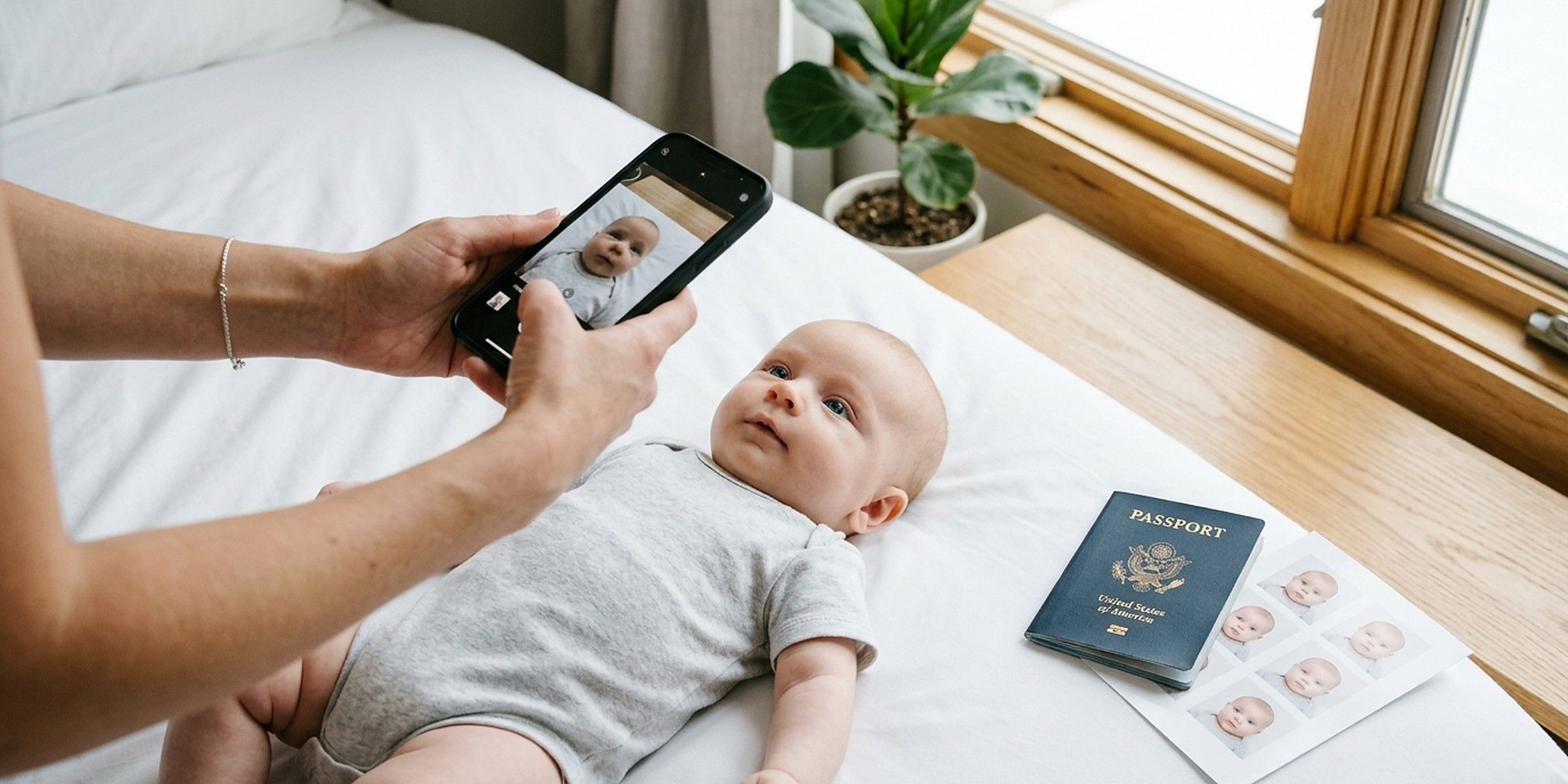
Every infant traveling internationally—even a two-week-old newborn—must carry their own individual U.S. passport with a compliant 2×2 inch (51×51 mm) biometric photograph. While the U.S. Department of State relaxes eye-contact and expression rules for newborns under one year old, it strictly enforces a zero-hands, zero-pacifier, and pure white (#FFFFFF) background mandate. Rather than holding a squirming baby under harsh pharmacy fluorescent lights, you can photograph your infant flat on a bedsheet or in a draped car seat at home and use our US passport photo tool (or our Canadian child passport photo generator for dual-citizen families) to verify 478 biometric points, erase wrinkled fabric to pure white, and get a 100% acceptance guarantee.
- Exact 2×2 Inch Framing: Infant photos share the exact adult size: 2×2 inches (51×51 mm) in print (
1200×1200 pxat600 DPIdigitally), with a chin-to-crown head height of 1 to 1⅜ inches (25–35 mm / 50%–69%) on a pure white (#FFFFFF) background. - The Newborn Eyes-Closed Exception: For newborns and young infants under 12 months, it is officially acceptable if the baby's eyes are partially open or gently closed, and a slightly parted mouth is permitted as long as the face is calm and centered.
- Strict Zero-Hands & Zero-Pacifier Rule: No parent hands, fingers, arms, pacifiers, bibs, toys, hair bows, or exposed car seat buckles may appear anywhere in the frame—any visible support hand triggers an automatic Form DS-11 rejection.
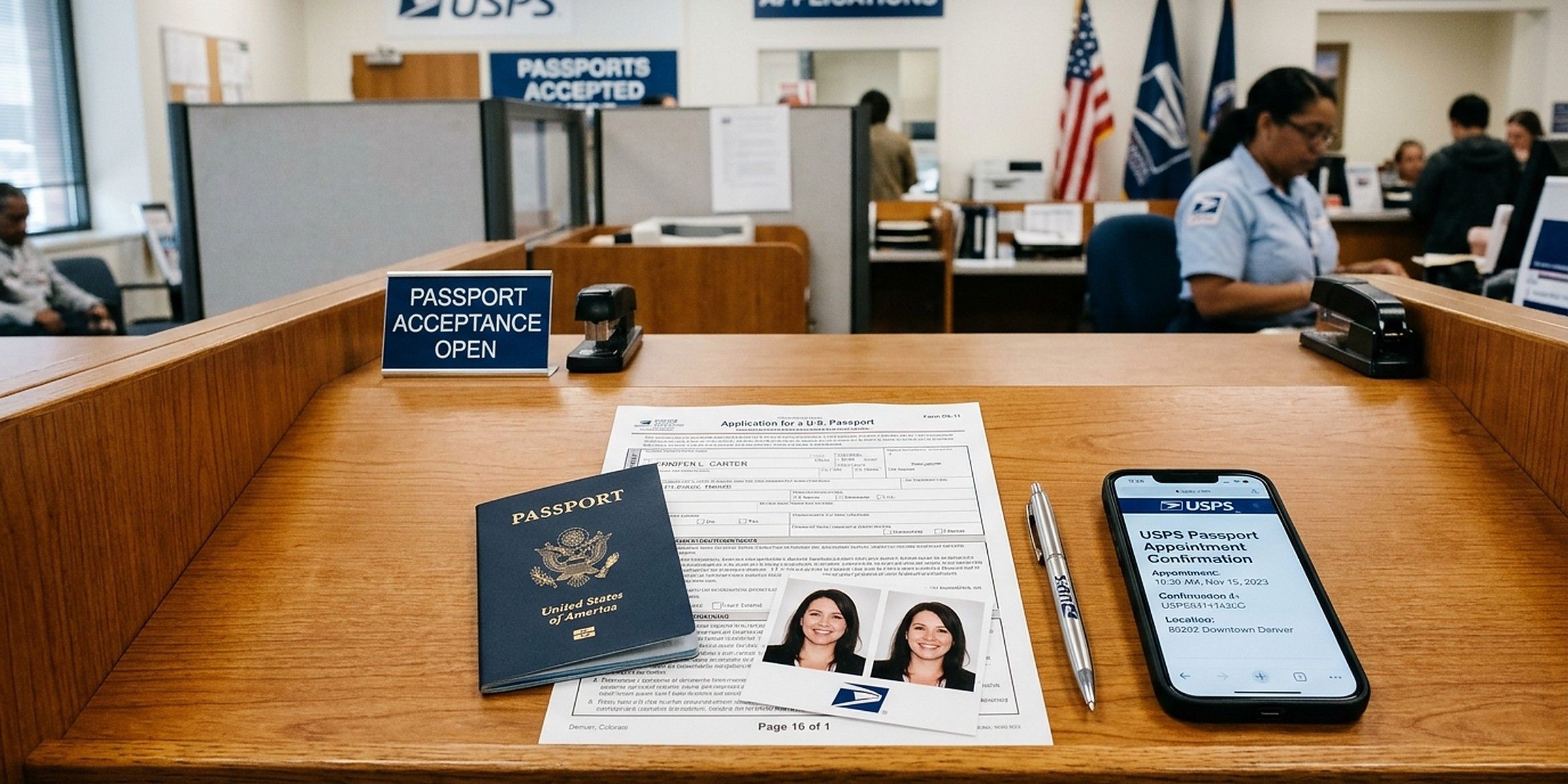
- In-Person Form DS-11 & Two-Parent Consent: All children under 16 must apply in person with a physical
2×2"print, both parents present (or a notarized Form DS-3053 signed within 90 days), and $135 in routine government fees for a 5-year passport book.
Photographing an infant who cannot yet hold their head up is one of the most stressful errands new parents face before an international family trip. Walk-in retail counters at Walgreens, CVS, and USPS are designed for standing adults, often leading to rejected applications when a parent's arm or a grey car seat strap creeps into the corner of the frame. Below is the complete 2026 U.S. Department of State technical breakdown, including the two government-endorsed home photography methods and the exact Form DS-11 parental consent checklist.
1. Official 2026 US Baby & Newborn Passport Photo Specifications (2×2 Inch)
An official U.S. baby or newborn passport photo must measure exactly 2×2 inches (51×51 mm), scale the infant's head height between 1 and 1⅜ inches (25–35 mm or 50%–69% of the frame), position the eyes 1⅛ to 1⅜ inches from the bottom border, and feature a plain pure white (#FFFFFF) background taken within the last 6 months.
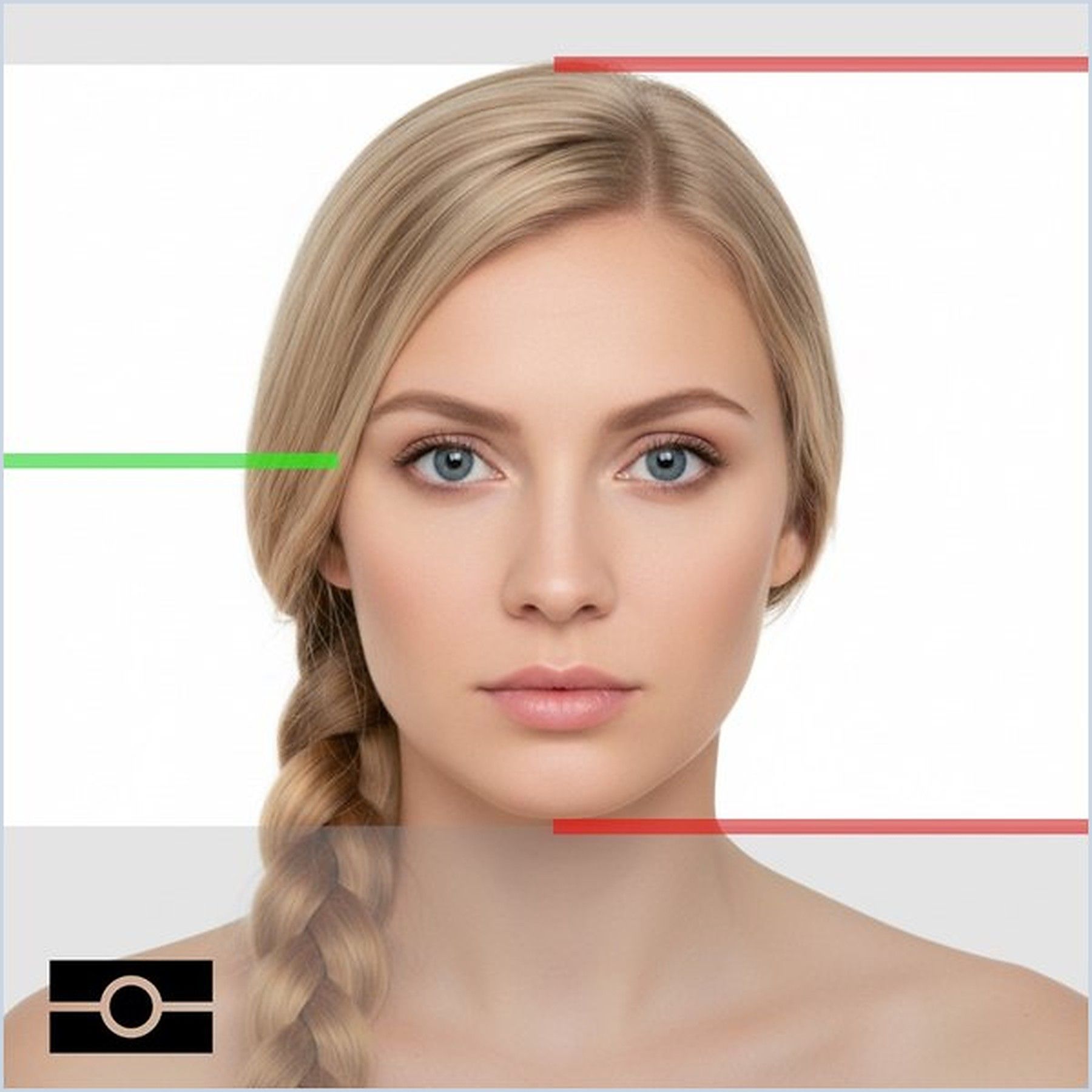
When a Passport Acceptance Agent at the post office or an adjudicator at the National Passport Processing Center inspects your infant's photograph, they place a clear plastic biometric gauge directly over the 2×2 inch print. While the federal government understands that a three-week-old newborn cannot follow verbal posing instructions like an adult, the physical geometry of the square print must still match the federal standard used for an adult passport or US visa photo.
| Biometric Parameter | Official U.S. Infant & Newborn Requirement (2026) | Adult Rule vs. Newborn (< 1 Year) Leeway |
|---|---|---|
| Physical Print Dimensions | Exact 2 × 2 inches (51 × 51 mm / 50.8 × 50.8 mm, 1:1 square) | Identical: Required for all Form DS-11 in-person minor filings. |
| Digital Resolution | 1200 × 1200 px at 600 DPI (600 × 600 px minimum in sRGB JPEG) | Identical: 600 DPI ensures crisp 4×6" pharmacy print sheets. |
| Head Height (Chin to Crown) | 1 inch to 1⅜ inches (25 mm to 35 mm, or 50% to 69% of frame height; Snap4ID target: 67.5%) | Identical: Measured from bottom of chin to top of skull (excluding bows/fuzz). |
| Eye Distance from Bottom | 1⅛ inches to 1⅜ inches (28.5 mm to 35 mm, or 56.25% to 68.75%) | Identical: Horizontal eye line must sit in the upper-middle zone. |
| Eyes Open & Eye Contact | Newborns may have eyes partially open or gently closed; toddlers must have eyes open | Relaxed for Newborns: Infants under 1 year do not need wide-open eyes or direct lens gaze. |
| Facial Expression | Calm, relaxed face; slightly parted lips allowed for infants if not crying | Relaxed for Infants: Slight open-mouth relaxation allowed; crying or scrunched faces rejected. |
| Background & Support | Uniform pure white (#FFFFFF) with zero parent hands, arms, or car seat straps | Strictly Enforced: Zero tolerance for visible hands, pacifiers, bibs, or shadows. |
| Photo Recency | Taken within the last 6 months and reflecting current infant appearance | Strictly Enforced: Do not reuse a hospital newborn photo for a 9-month-old baby. |
Do a Newborn's Eyes Have to Be Open in a US Passport Photo?
No, a newborn's eyes do not have to be wide open in a U.S. passport photo. According to the U.S. Department of State official passport photo guidelines (Travel.State.Gov), for newborns and very young infants under one year of age, it is acceptable if the baby's eyes are not open or not looking squarely at the camera. Federal biometric auditors recognize that newborns sleep up to 17 hours a day and instinctively squeeze their eyelids shut under bright room lights.
However, this exception applies specifically to sleeping or drowsy newborns with a calm, relaxed face. If an infant is crying, screaming, grimacing, or scrunching their cheeks so tightly that the distance between the eyes, nose, and chin is distorted, the photo will be rejected. For older infants and toddlers aged 6 to 12 months and up who can sit upright and track objects, acceptance agents expect both eyes to be open and facing forward. Similarly, while adults must keep their lips firmly closed, the State Department permits a baby's mouth to be slightly parted in a relaxed state, provided the tongue is not sticking out and no pacifier is present.
Non-Negotiable Infant Rules: Zero Parent Hands, Pacifiers, or Hair Bows
While the U.S. Department of State is forgiving about a newborn's sleepy eyelids, adjudicators enforce zero tolerance on four physical framing violations that account for over 85% of infant passport photo rejections:
- Zero Parent Hands, Fingers, or Arms in the Frame: No other person—and no part of a parent's hand, wrist, or shoulder—may be visible holding the baby's head, neck, or sides. Even if you wrap your hand in a white towel or wear a white long-sleeved shirt to "blend in," automated edge-detection scanners will flag the outline of your fingers and reject the application.
- Zero Pacifiers, Bottles, Teethers, or Drool Bibs: Pacifiers (including transparent silicone hospital pacifiers), pacifier clips attached to the collar, nursing pillows, and bibs obscure the lower chin and neckline and trigger an immediate rejection.
- Zero Hair Bows, Headbands, Bonnets, or Hospital Beanies: Large decorative nylon headbands, floral bows, sun hats, and knit caps are strictly prohibited. Biometric scanners must see the baby's natural skull contour to verify the
1 to 1⅜ inchhead height. - Zero Car Seat Buckles, Chest Clips, or Overhead Nursery Shadows: Exposed grey plastic harness straps behind the baby's shoulders or dark crescent shadows cast behind the ears by an overhead ceiling fixture violate the uniform white background rule.
2. How to Take a Newborn Passport Photo at Home: White Sheet vs. Car Seat Method
The two U.S. Department of State-approved ways to photograph a baby at home without visible parent hands are the Lay-Down White Sheet Method (best for newborns aged 0–6 months who cannot sit up) and the Covered Car Seat Method (ideal for infants aged 3–12 months who need upright torso support).
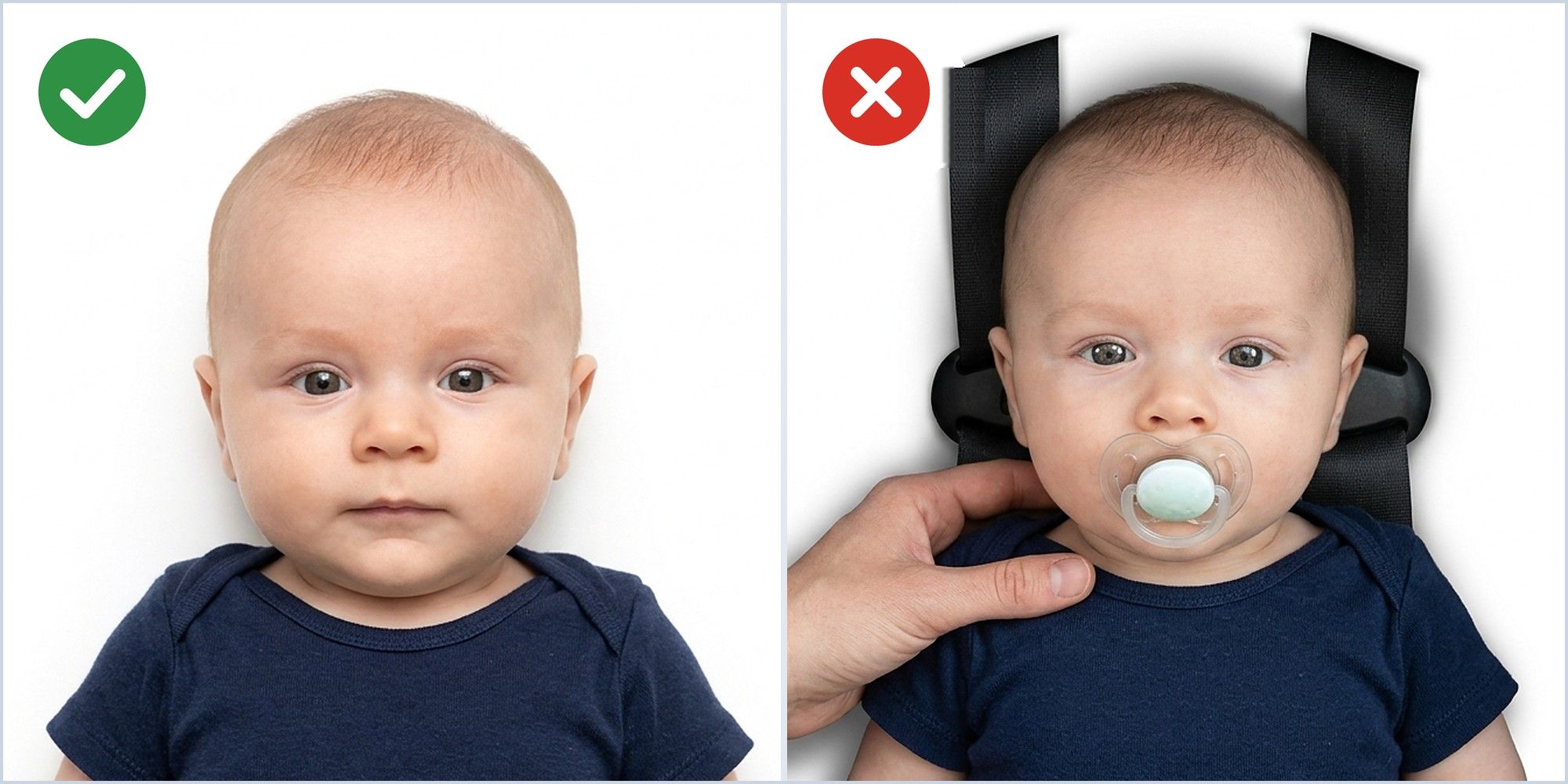
✔ DO: State Dept Approved Infant Setup
- Lay newborns flat on a plain white sheet: Position your baby on their back near a bright window so natural daylight illuminates both cheeks evenly without harsh shadows.
- Tuck a rolled washcloth under the sheet: If your newborn's chin drops toward their chest, slip a small rolled towel underneath the white sheet behind their upper shoulders to level their gaze.
- Dress your baby in a solid dark or bright onesie: Choose navy, burgundy, forest green, or royal blue so your baby's shoulders contrast sharply against the white background.
- Use Snap4ID to erase sheet wrinkles to #FFFFFF: Let our 478-point biometric AI replace creased fabric or car seat edges with a flawless pure white canvas.
✘ DON'T: Instant Infant Rejection Mistakes
- Don't hold your baby's head with your hands: Never let fingers, hands, wrists, or a parent's chest appear behind the baby—even if draped in white cloth.
- Don't leave pacifiers, bibs, or hair bows on: Remove all pacifiers, pacifier straps, drool bibs, and decorative headbands before snapping the photo.
- Don't photograph in an uncovered car seat: Visible black nylon harness straps, padded headrests, or patterned stroller canopies cause immediate rejection.
- Don't use camera flash or overhead nursery lamps: Direct flash startles infants and casts dark halo shadows behind the ears onto the bedsheet.
Method 1: The Lay-Down White Sheet Technique (Best for Newborns 0–6 Months)
For newborns and infants under six months old who have not yet developed neck control, the Lay-Down White Sheet Method is by far the safest, calmest, and most reliable technique:
- Time It Right After a Feeding & Diaper Change: Plan a 10-minute window in the morning or early afternoon right after your baby has been fed and burped, when they are calm and alert.
- Smooth a Plain White Sheet Near a Window: Lay a clean white cotton bedsheet, receiving blanket, or piece of white poster board flat over a firm mattress, changing pad, or living room rug about 3 to 4 feet away from a bright window. Turn OFF overhead yellow ceiling bulbs so all light is soft, diffused daylight.
- Prevent the "Chin-to-Chest" Roll: Because newborns have a prominent back of the skull (occiput), lying flat on a firm surface often tips their chin down into their chest. If this happens, roll up a small baby washcloth and place it underneath the white sheet beneath your baby's shoulder blades—this gently elevates the chest and tips the face parallel to the ceiling with zero visible props.
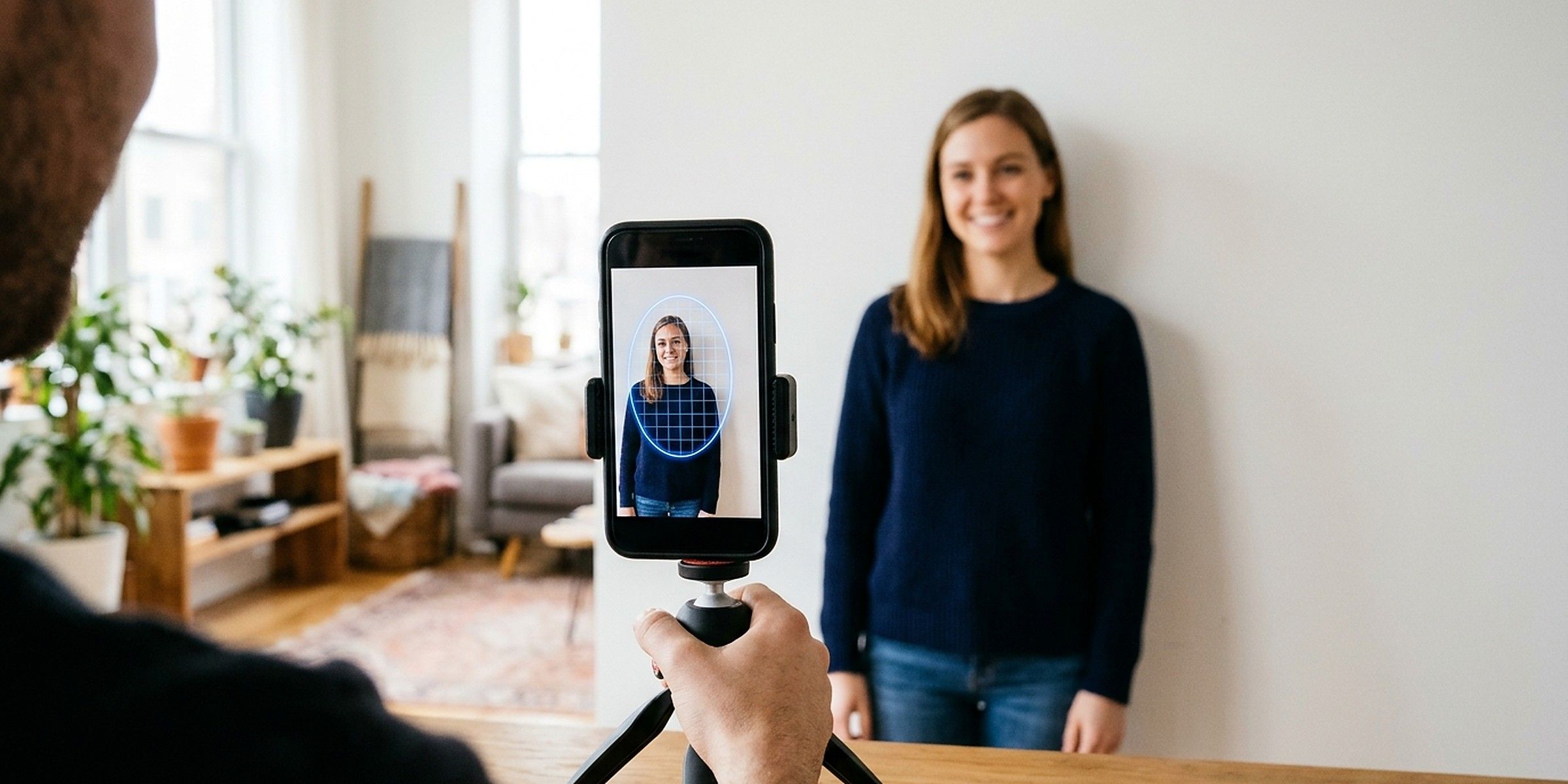
- Stand Directly Above at 3–4 Feet & Shoot in Burst Mode: Hold your smartphone directly above your baby's chest and face, keeping the phone strictly parallel to the floor so you don't shoot at a downward angle. Stay 3 to 4 feet (90–120 cm) away (use
1.5×or2×optical zoom rather than holding the phone 12 inches from their nose, which causes wide-angle lens distortion). Shake a soft rattle right beside the camera lens and snap 15 to 20 photos in rapid burst mode.
Method 2: The Official Travel.State.Gov Covered Car Seat Hack (3–12 Months)
If your baby is between 3 and 12 months old and gets fussy lying flat on their back—or has mild reflux—the U.S. Department of State explicitly recommends the Covered Car Seat Method:
- Drape a Tightly Pulled White Sheet Over the Car Seat: Take a plain white bedsheet and drape it completely over your infant's bucket car seat or bouncer so that the patterned fabric, foam headrest wings, and five-point harness straps are 100% covered.
- Support From Underneath If Necessary: If you must stabilize the baby's torso, reach your hand behind and underneath the white sheet or inside the back of the baby's shirt so zero fingers or fabric bulges appear beside their neck or cheeks.
- Face the Car Seat Toward a Bright Window: Place the sheet-covered car seat facing a window (never with the window behind the car seat, which backlights the baby's face in shadow) and hold your smartphone at the baby's exact eye level from 4 feet away.
What Should a Baby Wear for a Passport Photo? (Why Dark Onesies Beat White)
Counter-Intuitive Infant Clothing Trap: Do not dress your newborn in a pure white onesie, white christening gown, or pale ivory sleeper when laying them on a white sheet! When a white collar blends into a #FFFFFF white background, the baby's shoulders disappear and produce a "floating head" effect that automated State Department scanners flag as an indistinct body boundary.
Always dress your infant in a solid, medium-to-dark or vibrant colored onesie or top—such as navy blue, cobalt blue, burgundy, forest green, charcoal grey, or deep plum—with a simple crew neckline that sits right at the collarbone. Avoid hoodies (the bunched hood behind the neck looks like a head covering or pillow), ruffled bibs, and sleeveless spaghetti-strap rompers that get cropped out below the bottom edge of the 2×2 inch square. For a broader overview of adult and child framing rules, see our guide to the DOs and DON'Ts on a US passport photo.
3. How Snap4ID's 478-Point Biometric AI Fixes Wrinkled Sheets & Baby Framing
Snap4ID's infant biometric engine maps 478 biometric points on your baby's face, automatically strips away wrinkled bedsheets, nursery shadows, or exposed car seat corners to pure white (#FFFFFF), scales the chin-to-crown height to the exact 1 to 1⅜ inch (50%–69%) federal zone, and backs every photo with a 100% acceptance guarantee.
Why Walgreens, CVS, and USPS Counters Struggle with Newborn Photos
If you call your local Walgreens, CVS, or UPS Store before visiting with a newborn, many branches will tell you outright that they only photograph children who can sit or stand unassisted. At stores that do agree to try, there is no clean table or floor mat to lay an infant down. Instead, a cashier pulls down a narrow vinyl roller screen in a busy shopping aisle and asks you to hoist your baby up in the air like The Lion King while crouching below the frame—nearly always leaving your hands, thumbs, or forehead visible behind the infant's neck and costing you $16.99 for a photo that gets rejected three weeks later.
When you take the photo at home and upload it to our US passport photo tool, you eliminate every retail obstacle at once:
- Automatic Bedsheet Wrinkle & Shadow Removal: Even if your cotton bedsheet has fold creases, mattress depressions, or slight grey shadows behind your baby's ears, Snap4ID's AI segmentation cleanly isolates the infant's head and shoulders and replaces the backdrop with a uniform
#FFFFFFpure white canvas—with zero jagged halo edges around wispy newborn hair. - 478-Point Infant Landmark Calibration: Our algorithm detects 478 biometric points across your baby's facial oval, automatically rotating a slightly crooked overhead shot so the eyes sit level at
1⅛ to 1⅜ inchesfrom the bottom edge and locking the head height at the optimal67.5%(1.35 inches) ratio. - 100% Acceptance Guarantee (Full Money-Back Guarantee): Every download includes both the high-resolution
1200×1200 px(600 DPI) digital JPEG and a calibrated4×6 inchprint sheet backed by our full money-back acceptance guarantee if rejected by any U.S. passport agency.
How to Print a $0.39 4×6 Baby Passport Photo Sheet for Form DS-11
Because all passport applications for children under 16 must be filed in person using paper Form DS-11, you must bring a physical printed 2×2 inch photograph to your appointment. Instead of paying $16.99 at the pharmacy counter, simply upload your Snap4ID 4×6 inch print sheet to the Walgreens or CVS mobile app as a regular "Standard 4×6 Glossy Print" for $0.39 to $0.42 with 1-hour pickup. Make sure to select "Do Not Crop / Full Image" in the app preview, then cut out one 2×2 inch square with scissors at home. For step-by-step kiosk screenshots, read our full guide on printing a $0.39 4×6 passport photo sheet at Walgreens or CVS.
4. Applying for a Baby's US Passport: Form DS-11, Form DS-3053 Consent & Fees
To apply for a baby or newborn U.S. passport in 2026, both parents and the infant must appear in person at an authorized acceptance facility with Form DS-11, the child's certified birth certificate, parent photo IDs, one loose 2×2 inch photo (do not staple it), and $135 in total routine fees ($100 State Department fee plus $35 execution fee).
How the Two-Parent Rule & Notarized Form DS-3053 Work
Under federal anti-abduction statutes enforced by the U.S. Department of State Children Under 16 Passport Application Rules, three people must physically attend a baby's passport appointment: the infant plus both legal parents/guardians. Even if your baby is only ten days old, the Acceptance Agent must visually verify the infant in person against the 2×2 inch photograph.
If one parent cannot attend the appointment due to work, military deployment, or travel, the applying parent must bring an original, physically signed and notarized Form DS-3053 (Statement of Consent: Issuance of a U.S. Passport to a Child) completed by the non-applying parent. Avoid these three common Form DS-3053 rejection traps:
- Strict 90-Day Notarization Window: Form DS-3053 must be signed in black ink in the presence of a certified Notary Public and submitted within 90 calendar days of the notarization date.
- Front-and-Back ID Photocopy Mandatory: You must attach a clear photocopy of the front AND back of the exact government photo ID (driver's license or passport) that the absent parent presented to the notary. Forgetting the back side of the driver's license is the #1 administrative cause of DS-11 hold letters.
- Sole Legal Custody Documentation: If only one parent has sole legal authority, you must submit the original certified court order granting sole legal custody, a certified birth certificate listing only one parent, or a certified death certificate of the other parent (or Form DS-5525 in rare exigent circumstances where the other parent cannot be located).
Do You Need a New Passport Photo As Your Baby Grows? (The 5-Year Validity Rule)
No! One of the most frequent misconceptions among traveling parents is that a newborn passport becomes invalid once the child grows hair, loses baby fat, and turns into a three- or four-year-old preschooler. In reality, a U.S. minor passport issued to a newborn is legally valid for its entire 5-year term until the expiration date printed inside the book. U.S. Customs and Border Protection (CBP) officers and international airline gate agents are trained to verify infant-to-child facial bone structure (interpupillary distance and ear-to-nose geometry) and never require you to renew a child's passport early merely due to normal childhood growth.
5. Frequently Asked Questions (Baby & Newborn US Passport Photos)
Can a newborn's eyes be closed in a US passport photo?
Yes, for newborns and very young infants under one year old, the U.S. Department of State officially permits eyes to be partially open or gently closed if the baby cannot stay awake or focus on the lens. However, the baby's face must still be squared toward the camera with a calm, tear-free expression and zero hands or pacifiers in the frame.
Can I hold my baby in their passport photo if my hands are covered by a white sheet?
No, if the outline of a parent's hands, fingers, or arms is visible supporting the infant's head or torso—even underneath a white sleeve or towel—the U.S. Department of State will reject the photo. Instead, lay the baby flat on their back on a white cotton sheet or place them in a white-sheet-draped car seat so no supporting hands enter the 2×2 inch frame.
Can a baby wear a headband, hair bow, or pacifier in a US passport photo?
No, pacifiers, pacifier clips, teethers, bibs, decorative headbands, floral hair bows, and hospital beanies are strictly prohibited in U.S. infant passport photos. Pacifiers obscure the mouth and jawline, while bows and headbands hide the natural top of the skull needed to verify the mandatory 1 to 1⅜ inch head height.
Do I need to get a new passport when my newborn grows into a toddler?
No, you do not need to replace a baby passport simply because your child grows hair, gains weight, or matures into a toddler or preschooler. A U.S. child passport issued to a newborn remains 100% legally valid for international travel for its full 5-year validity period until the printed expiration date.
How much does a baby passport cost in the US in 2026?
In 2026, a routine U.S. Child Passport Book for an applicant under age 16 costs $135 total, consisting of a $100 U.S. Department of State application fee and a mandatory $35 in-person execution fee paid to the USPS or county acceptance facility. Adding optional Expedited Service costs an extra $60 per application.
Can I submit a digital photo for a baby passport, or do I need a physical 2×2 inch print?
You must bring one physical printed 2×2 inch (51×51 mm) photo because all U.S. passport applications for children under age 16 must be submitted in person on Form DS-11 and are ineligible for MyTravelGov online renewal. With Snap4ID, you get both the digital file and a calibrated 4×6 inch sheet you can print at Walgreens or CVS for $0.39.
Skip the stressful pharmacy trip. Snap a photo of your newborn lying on a bedsheet or sitting in a car seat—Snap4ID checks 478 biometric points, erases the background to pure white (#FFFFFF), and gives you a 1200×1200 px digital file plus a $0.39 4×6" print sheet with a 100% acceptance guarantee. Create Your Baby's 2×2 US Passport Photo Now →